When you purchase through contact on our situation , we may earn an affiliate commission . Here ’s how it works .
Humans are of course funny and creative , two traits that have result our mintage to many scientific and technological breakthrough . Since our earliest ancestors sock a rock-and-roll on the background to make the first sharp - edged tool , humans have proceed to introduce . From the launching of the wheel to the launching of Mars rovers , several of these key advancements support out as especially revolutionary . Some invention are thanks to one eureka moment , but most of our most pioneering inventions were the piece of work of several innovational thinker who made incremental advance over many years . Here , we search 22 of the most important inventions of all time , along with the science behind the inventions and how they came about .
1. GPS
Global pilotage used to be a hard endeavor . Compasses , maps , marine chronometer and the maven helped humans populate almost every niche of Earth , but those methods are far less utile for precisely navigating an aircraft or nameless landscape on foot .
Enter the Global Positioning System ( GPS ) , a internet of satellites that perpetually transmit signaling that anyone on Earth can use to determine their precise emplacement — provide they have a simple GPS pass catcher . It has revolutionized transportation and permit for navigation apps like Google Maps and Waze .
Today , there are31 operational GPSsatellites in Earth arena , up from an initial 24 launched by the U.S. Department of Defense ( DOD ) between 1978 and 1993 and not include the 42 decommission satellites still in orbit . These are operated alongside the three other satellite navigation constellation : Russia’sGLONASS , China’sBeiDou , and the European Union’sGalileo .

The light bulb is one of the inventions changed the world.
GPS save lives every day : Emergency worker expend it in wild rescues , police practice it to track defendant , and those traveling off the flummox path expend it to return to civilization .
An unusual scene of GPS that chip in to its speedy adoption by is that it is lock for costless by the U.S. government . That rollout happened in the backwash of a tragic incident in 1983 , in which a South Korean rider aircraftwas shot downafter mistakenly entering Soviet air space . In response , then - President Ronald Reagan decided the organisation should be undefendable to the public to prevent standardised consequence from happen .
2. Smartphones
Although the telephone is already on this list , the smartphone has driven a gyration in personal , portable computation since its invention in the past few decades .
The accurate moment when cellphones crossed the roadblock to smartphones is hard to set . An former twist desirable of the title is 1994 ’s IBM Simon , a multi - functional earphone that could also send emails and moderate a personal PDA . However , almost nobody used it . Other noteworthy entry include the Blackberry , which wasunveiled in 2000and revolutionized mobile web browse , and , of course , the first iPhone , which , in 2007 introduced the spot - screen pattern that ’s omnipresent today .
Smartphones have been a launchpad for social medium and instant electronic messaging apps and have combined multiple forms of technology into one small gimmick . Most citizenry use their smartphones as a compounding of cellphone , computer , camera and organizer , but these mobile devices can also act as smart detector , navigational machine , microphone , billfold and more .

GPS is a staple in most modern cars and phones.
3. Wheel
Before the conception of the wheel in 3500 B.C. , humanity were gravely limited in how much stuff we could ship over estate , and how far . The wheel itself was n’t the most difficult part of " contrive the bike . " When it occur prison term to connect a non - moving platform to that peal cylinder , thing got slick , according to David Anthony , an emeritus professor of anthropology at Hartwick College .
" The cam stroke of grandness was the wheel - and - axle concept,“Anthony previously told Live Science . " But then making it was also difficult . " For instance , the holes at the center of the wheels and the ends of the unsex axle had to be most perfectly round and smooth , he state . The size of the axle was also a critical factor , as was its snugness inside the pickle ( not too tight , but not too loose , either ) .
The knockout work paid off , big time . Wheeled carts facilitate factory farm and commerce by enabling the transportation of goods to and from market , as well as ease the burdens of people travel great distances . Now , wheels are lively to our way of life , found in everything from alfilaria to vehicle to turbine .

Steve Jobs announces the new iPhone in 2010.
David Anthony is prof emeritus and curator emeritus of anthropology at Hartwick College in Oneonta , New York . He has done extensive archeological fieldwork in Ukraine , Russia and Kazakhstan . Anthony is the writer of " The Horse , the Wheel , and Language " ( Princeton , 2007 ) and has co - authored studies including the find thathumans first rode horses 5,000 years ago .
4. Printing press
German discoverer Johannes Gutenberg invented theprinting presssometime between 1440 and 1450 . Key to its development was the mitt mould , a new moulding technique that enabled the speedy macrocosm of prominent quantities of metal movable eccentric . Though others before him — including inventors in China and Korea — had developed movable type made from metallic element , Gutenberg was the first to create a mechanised summons that transferred the ink ( which he made from linseed oil and smut ) from the transferable character to composition .
With this moveable type process , printing mechanical press exponentially increased the speed with which record written matter could be made , and thus they led to the rapid and widespread dissemination of cognition for the first time in story . In her record “ The Printing Revolution in Early Modern Europe ” ( Cambridge University Press , 2012 ) , late historian Elizabeth L. Eisenstein wrote , “ printer ’ workshops would be launch in every important municipal essence by 1500 . ” It has been estimated that up to twenty million volumes had been print in Western Europe by 1500 , although Eisenstein estimates that it was around eight million .
Among other things , the printing press permit wider access code to the Bible , which in turn head to alternative interpretations , including that of Martin Luther , whose " 95 Theses " a document printed by the hundred - thousand sparked the Protestant Reformation .

Wheels were invented circa 3,500 B.C., and rapidly spread across the Eastern Hemisphere.
5. Penicillin
It ’s one of the most famous find story in history . In 1928 , the Scotch scientist Alexander Fleming noticed a bacteria - filled Petri dish in his research lab with its lid incidentally ajar . The sample distribution had become contaminated with a mold , and everywhere the mold was , the bacteria was utter . That antibiotic mold turned out to be the fungus Penicillium , and over the next two decades , chemist purified it and developed the drugpenicillin , which campaign a huge number of bacterial infection in human being without harming the human beings themselves .
Penicillin was being aggregated - acquire and advertize by 1944 . This poster attached to a curbside mailbox advised World War II servicemen to take the drug to rid themselves of venereal disease .
About 1 in 10 the great unwashed havean hypersensitised reaction to the antibiotic , agree to a subject print in 2003 in the diary Clinical Reviews in Allergy and Immunology . Even so , most of those people go on to be able to tolerate the drug , researchers say .

A 19th-century engraving of Gutenberg printing the first page of the Bible
Related : What causes allergies ?
6. Compass
Ancient mariners used the virtuoso for navigation , but this method did n’t influence during the day or on mirky nights , make it dangerous to travel far from land .
The first compass was cook up in China during the Han dynasty between the second Century B.C. and 1st Century A.D. ; it was made of lodestone , a naturally - magnetize iron ore , the attractive property of which they had been studying for centuries . However , it was used for navigation for the first time during the Song Dynasty , between the 11th and 12th 100 ,
Soon after , the technology to the West through nautical contact . The compass enable Jack to navigate safely far from land , opening up the world for geographic expedition and the subsequent ontogeny of globose barter . An pawn still wide used today , the compass has transform our cognition and understanding of the Earth forever .
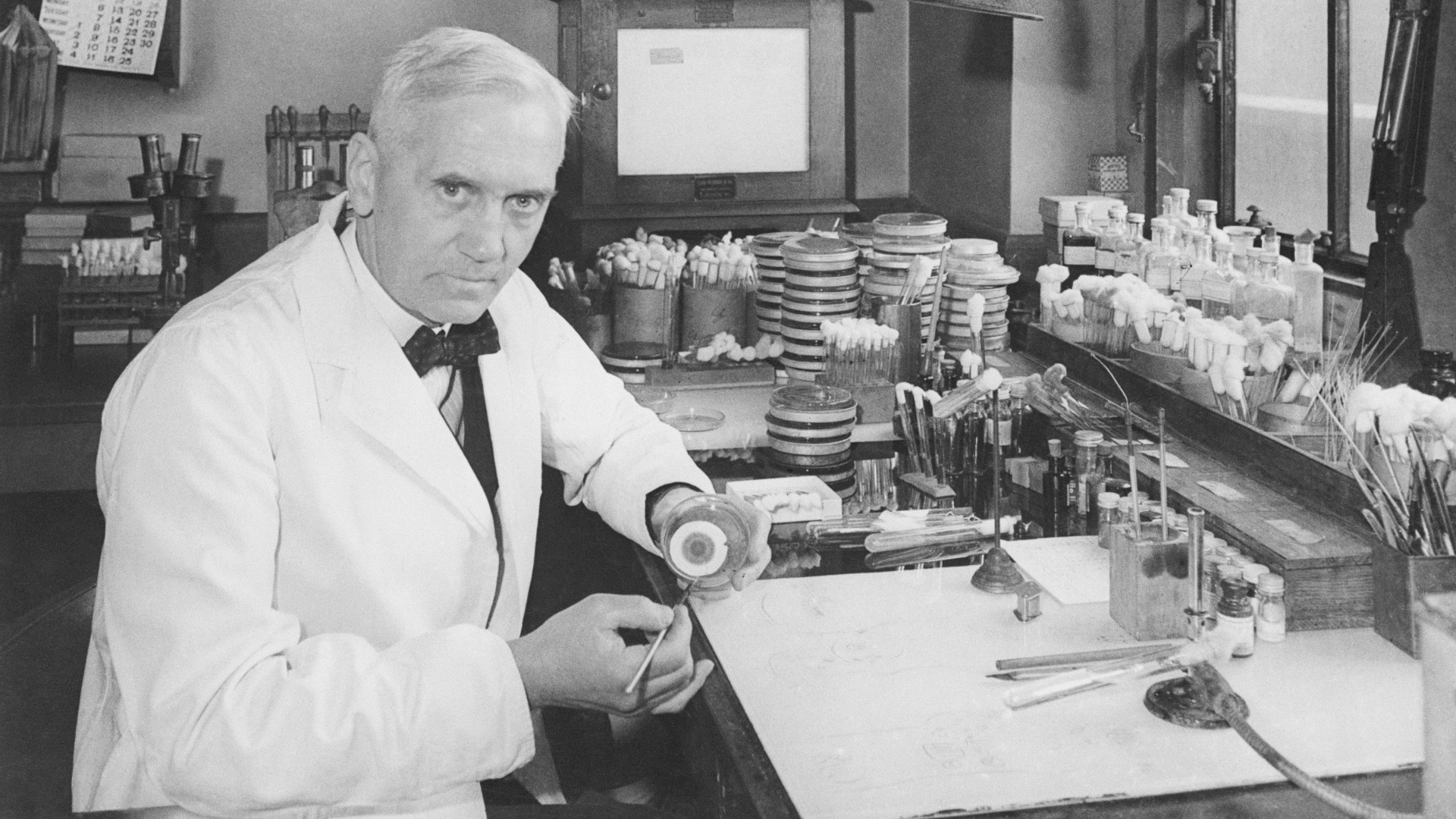
Alexander Fleming pictured in his laboratory
7. Light bulb
Theinvention of the lightness bulbtransformed our world by take out our dependence on born light , allowing us to be productive at any time , 24-hour interval or night . Several inventors were subservient in developing this revolutionary technology throughout the 1800s ; Thomas Edison is credited as the primary inventor because he created a completely functional lighting system , including a source and wiring as well as a C - fibril bulb like the one above , in 1879 .
As well as lead up the introduction of electricity in homes throughout the Western public , this invention also had a rather unexpected consequence ofchanging people ’s eternal sleep pattern . or else of going to bottom at dusk ( having nothing else to do ) and sleeping in segment throughout the night separated by periods of wakefulness , we now stay up except for the 7 to 8 hours deal out for slumber , and , ideally , we sleep all in one go .
8. Telephone
Several discoverer did pioneering work on electronic voice infection — many of whom later filed intellectual property case when phone exercise detonate — but it was Scottish artificer Alexander Graham Bell who was the first to be present a letters patent for the galvanising phone on March 7 , 1876 ( his patent drawing is pictured above ) . Three days subsequently , Bell made the first telephone set call to his assistant , Thomas Watson , saying " Mr Watson , come here — I want to see you , " accord to writer A. Edward Evenson in his al-Qur’an , “ The Telephone Patent Conspiracy of 1876 : The Elisha Gray - Alexander Bell Controversy and Its Many Players ” ( McFarland , 2015 ) .
Bell ’s inspiration for the telephone was influenced by his category . His father taught speech elocution and specialized in teaching the indifferent speak , his female parent , an accomplished musician , lose her hearing in later spirit and his wife Mabel , who he wed in 1877 , had been deaf since the age of five , concord to Evenson . The excogitation quickly took off and revolutionized global business and communicating . When Bell died on Aug. 2 , 1922 , all telephone set inspection and repair in the United States and Canada was stopped for one minute to honour him .
9. Internal combustion engine
In these engines , the combustion of fuel releases a high - temperature gas , which , as it exposit , applies a military unit to a piston , move it . Thus , combustion engines change over chemical substance energy into mechanically skillful employment . Decades of engine room by many scientists went into design the inner combustion engine , which took its ( essentially ) modern form in the latter one-half of the nineteenth century . The engine ushered in the Industrial Age , as well as start the invention of a huge motley of machines , including advanced cars and aircraft .
Pictured are the operating footprint of a four - stroke internal combustion engine . The strokes are as come after : 1 ) Intake stroke — air and vaporised fuel are take out in . 2 ) Compression stroke - fuel vapor and air are compressed and ignited . 3 ) ability stroke — fuel combusts and the piston is pushed downward , power the machine . 4 ) exhaust system stroke — exhaust is driven out .
10. Contraceptives
Not only have nascence ascendence oral contraceptive , prophylactic and other forms of contraception sparked a intimate revolution in the highly-developed world by allowing men and woman to have sexual activity for leisure rather than procreation , they have also drastically subjugate the mediocre phone number of young per cleaning woman in countries where they are used . With fewer rima oris to feed , modernistic fellowship have achieved mellow standards of living and can provide well for each child . Meanwhile , on the global plate , contraceptives are helping the human population gradually pull down off ; our number will probably stabilize by the end of the C . Certain contraceptives , such as condoms , also hold the spread of sexually transmitted diseases .
Natural and herbal contraception has been used for millennia . Condoms or ‘ sheath ’ have existed in one form or another since ancient times , according to assimilator Jessica Borge in her Word “ Protective Practices : A History of the London Rubber Company and the Condom Business ” ( McGill - Queen ’s University Press , 2020 ) , with the rubber safe developed in the nineteenth century . Meanwhile , the FDA O.K. the first oral contraceptive anovulant in the United States in 1960 and by 1965 , more than 6.5 million American women were on the tablet , according to author Jonathan Eig in his book , “ The nascency of the Pill : How Four Pioneers Reinvented Sex and Launched a Revolution ” ( W. W. Norton & Company , 2015 ) .
scientist are continue to make forward motion in giving birth restraint , with some labs even pursuinga male form of " the oral contraceptive pill . “A lasting birth - ascendancy implant called Essure was approved by the Food and Drug Administration in 2002 , though in 2016 , the FDA warn the implant would need stronger warning to recount exploiter about serious risks of using Essure .

A reproduction of the world’s first compass
Related:7 surprising facts about the pill
11. Internet
The cyberspace is a global organisation of interconnect computer connection that is used by trillion of people worldwide . In the 1960s , a team of computing machine scientist working for the U.S. Defense Department ’s ARPA ( Advanced Research Projects Agency ) build a communication meshwork to connect the electronic computer in the agency , hollo ARPANET , the predecessor of the cyberspace . It used a method of data contagion called " parcel shift " , developed by computer scientist and team appendage Lawrence Roberts , found on prior work of other computing machine scientists .
This engineering was progressed in the 1970s by scientist Robert Kahn and Vinton Cerf , who spring up the crucial communicating communications protocol for the internet , the Transmission Control Protocol ( TCP ) and the Internet Protocol ( IP ) , harmonize to information processing system scientist Harry R. Lewis in his book “ idea That Created the Future : Classic Papers of Computer Science ” ( MIT Press , 2021 ) . For this , Kahn and Cerf are often credit as inventors of the internet ” .
In 1989 , the cyberspace evolve further thanks to the innovation of the World Wide Web by information processing system scientist Tim Berners - Lee while working at CERN ( The European Organization for Nuclear Research ) . According toCERN , " the canonic theme of the WWW was to combine the evolving technologies of electronic computer , datum web and hypertext into a powerful and easy to apply global information system . " The evolution of the WWW opened up the human race of the internet to everybody and connected the world in a way that it had never been before .

An original Edison light bulb from 1879 from Thomas Edison’s shop in Menlo Park, New Jersey.
link up : Inventor of World Wide Web split estimator science ’s top prize
12. Nails
This key invention date back more than 2,000 year to the Ancient Roman period and became possible only after humans developed the power to cast and form metal . Previously , Natalie Wood structures had to be built by lock next display panel geometrically a much more arduous construction process .
Until the 1790s and early 1800s , hand - wrought nails were the average , with a blacksmith heat a satisfying atomic number 26 rod cell and then hammer it on four sides to create a point , according to theUniversity of Vermont . Nail - making machines came online between the 1790s and the former 1800s . Technology for crafting nails continued to advance ; After Henry Bessemer developed a mental process to mass - garden truck steel from iron , the smoothing iron nail of yesteryear slowly waned and by 1886 , 10 pct of U.S. nail were created from lenient steel wire , according to the University of Vermont . By 1913 , 90 pct of nail produced in the U.S. were blade wire .
Meanwhile , the conception of the screw - a stronger but difficult - to - insert holdfast - is usually impute to the Hellenic scholar Archimedes in the third century B.C. , but was in all likelihood invented by the Pythagorean philosopher Archytas of Tarentum , accord to David Blockley in his Scripture “ Engineering : A Very Short Introduction ” ( Oxford University Press , 2012 ) .
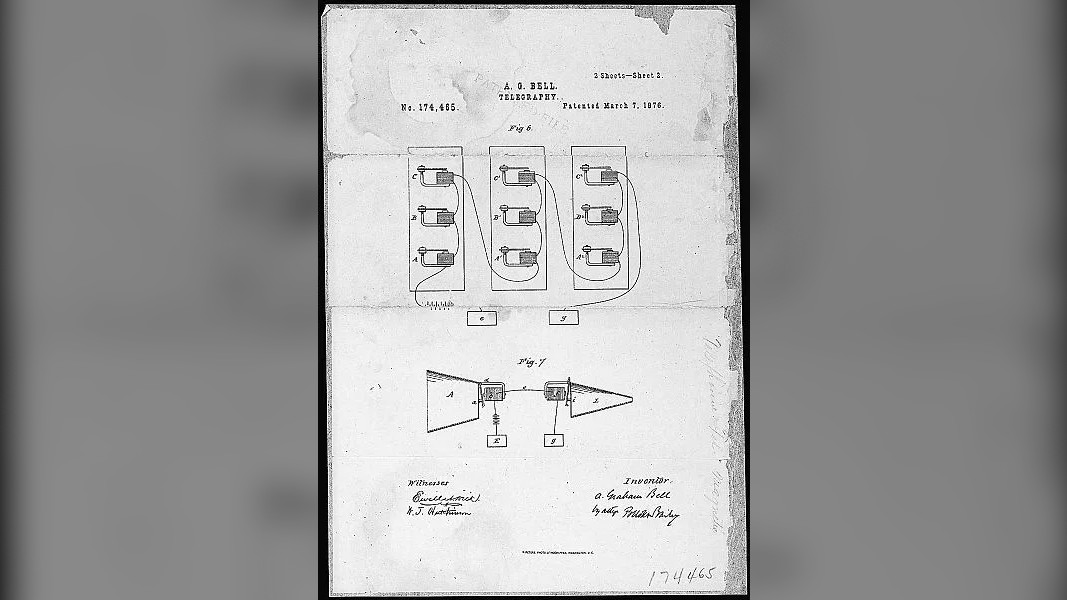
Alexander Graham Bell’s Telephone patent drawing, from 1876. Bell’s telephone was the first apparatus to transmit human speech via machine.
13. Use of fire
The use of flaming is one of mankind ’s most hefty early inventions and radically exchange the way our ancient ascendent lived . Offering fondness and the ability to cook foods such as gist , the campfire was also a social gathering post . Fire also provided some protection against predators .
The precise date fire was discovered has long stay a mystery , with some studies suggest it was first used by hominins inKenya 1 million yearsago to cook meat . Other grounds hint thatNeanderthalsin Europe and Asiaharnessed fire , whileHomo sapiensevolving in Africa mastered the skill of create fervency . More late , archaeologists in Israelfound grounds of hominin fire use go steady to 1.5 million to 2 million eld ago .
14. Concrete
Ancient Romans are credit as one of the first bon ton to expend concrete in architecture , with papistical bathhouses and iconic sites such as the Colosseumand Pantheon bonce construct using concrete mixed with volcanic ash , calx , and seawater . Incredibly , many of these ancient building are not only stomach , but continue in upright condition some 2,000 twelvemonth after — a testament to thelongevity of Roman concrete . However , the ancient Egyptians used a crude form of concrete in their buildings much sooner in 3000 B.C. , employing forms of concrete mixed with ash tree and table salt water to make mortar . One survey concluded that parts of the Great Pyramids ofGiza might have been build using concrete . Concrete is strong in compression but breaks easy in tension , so theinvention of reinforced steel - concretetoward the end of the nineteenth one C in France , which lends concrete some of steel ’s tensile strength , enabled concrete to be used more widely in twist .
15. Magnifying glass
Franciscan mendicant and Oxford University scholar Roger Bacon first develop the magnifying glass in 1268 . Sometimes dubbed " Britain ’s first scientist , " ' Bacon ’s magnifying glass built on research byMuslim scholars .
However , the function of optical tools date stamp back much further . grounds suggests that as early as 700 B.C. , people inancient Egyptnoticed that they could count through crystals to improve visual sensation .
16. Batteries
The first stamp battery see back to 1800 , when Italian physicistAlessandro Voltawrapped stack discs of copper and zinc in a cloth , overwhelm it in piquant piddle and discovered that it conducted energy . In 1802 , Scottish prof William Cruickshank excogitate a mutation of Volta ’s pattern bed as thetrough shelling , which consist of 50 record of fuzz and atomic number 30 in a wooden box fill up with a salt result to conduct energy . However , it was Gallic physicist Gaston Planté who invented the first practically used battery , in 1859 . Modern pas seul on Planté’srechargeable lead - loony toons batteryare still used in automobile today .
17. Marine chronometer
The 15th century marked the beginning of the great voyages of uncovering by adventurers and sea merchant and the maturation of aglobal sea trade electronic connection . Trading vessels carried highly jimmy silk , spice , salt , wine and teatime across often - treacherous sea for months on terminal . After the loss of four ship at sea in theScilly naval tragedy of 1707 , Jack-tar realized they needed an accurate way to find out longitude when out of sight of land .
In 1714 , the British parliamentoffered a prizeof 20,000 pounds to anyone who could solve the trouble . Carpenter John Harrisonwon the bounteousness in 1735 with his marine chronometer . What is perhaps even more singular is that Harrison was a self - taught clockmaker . His ingenious timekeeping machine was powered by the rock motility of the ship rather than by gravity and could be used by crewman to accurately calculate longitude at sea .
18. Airplane
The ability for humans to fly has capture the imagination of discoverer for centuries , with thefirst human being - operated flighttaking position in 1783 when Joseph - Michael and Jacques - Ètienne Montgolfier take to the skies in a red-hot strain balloon . In 1853 British engineerGeorge Cayleydesigned the first glider to successfully take flight , but it was n’t until 1903 thatOrville and Wilbur Wright’splane became the first airplane to have a successful voyage . It not only took off from Kitty Hawk , North Carolina using its own power ; it flew and land without destruction , unlike many earlier aircraft inventions . TheWright brotherswere inspired by watching ' fowl in flight of steps . The glider took a page from bird ' wings but had a 32 - ft ( 10 meters ) wingspread .
19. Refrigerator
Refrigeration in some manikin has been around for thousands of years . reckon on the clime , ice or cold body of water was used to keep food frigid in ancient times . But hokey refrigeration did n’t come in until 1748 , when the physicianWilliam Cullenfirst demonstrated evaporative chilling . Further breakthroughs add up in 1834 , when a vapor - condensation system was develop byAmerican engineer Jacob Perkins . In 1876 , German railroad engineer Carl von Linde came up with a procedure of liquifying the gas , usher in the epoch of commercial refrigeration . In 1913 , American engineer Fred Wolfinvented the first domestic refrigerator , and as demand for fresh green goods grow , so did the number of households with refrigerators .
20. Nuclear energy
Nuclear energy was first discovered in the 1930s by Italian physicistEnrico Fermi , who found that bombarding atoms with neutrons could split up them , generating huge amounts of vigour . He go on to break the first atomic Ernst Boris Chain reaction at the University of Chicago . This successful experiment led to the development of several nuclear plants in the 1950s , withIdaholaunching the first nuclear plant life in 1951 with electricity produced from atomic energy at its Experimental Breeder Reactor I place . Obninskin the former Soviet Union became the first grid - connect nuclear power industrial plant in the macrocosm in 1954 , while Shippingport nuclear plant life , Pennsylvania became the first commercial nuclear plant in 1957 .
Nuclear powerremains widely used around the world today , generating approximately 10 % ofglobal energy .
One problem is that be atomic power plants use fission to separate atoms , and this bring forth radioactive center that take ages to decay . And the risks of nuclear disasters , such as those atChernobyland the Fukushima - Daiichi nuclear power plant , highlight the challenge of fission - base atomic power .

A four-stroke internal combustion engine. 1) Intake stroke - air and vaporised fuel are drawn in. 2) Compression stroke - fuel vapor and air are compressed and ignited. 3) Power stroke - fuel combusts and piston is pushed downwards. 4) Exhaust stroke – piston moves upwards and gasses created exit through exhaust valve.
So scientists are working to create useable nuclear fusion reactors , which could theoretically generate clean , limitless free energy . In 2022 , scientists reported a minor breakthrough : a fusion reactor that beget more energy than was put into it . However , we’re still a long path from a useable fusion reactor , experts say .
21. Vaccines
The World Health Organization ( WHO ) forecast that approximately2 million to 3 million livesare saved annually thanks to vaccinations against contractable diseases such as diphtheria , tetanus and rubeola .
The early vestigial vaccination is mean to date back to the 10th one C in China , when people inoculated small mark in the cutis with small Department of State of smallpox to supply security against the disease . But in 1796 , English physicianEdward Jennerdiscovered that milkmaids rarely caught or pass away of variola major because they were antecedently infected by thecowpox computer virus , also phone Vaccinia . So he usedcowpoxto develop a smallpox vaccinum . He inoculate an 8 - class - old boy with cowpox and then with smallpox , and the boy never caught the virulent scourge . Jenner ’s experimentation led to the founding of asmallpox vaccineand his oeuvre is regarded as the head start of immunology . In 1980 , smallpox was declaredofficially eradicatedby WHO . But scientist keep on to develop new life - save vaccines — most notably , the coronavirus vaccine that played a large purpose in combatting thepandemic .
22. X-rays
Like many celebrated inventions , the X - light beam was discovered by accident . In 1895 , German engineer and physicistWilhelm Conrad Röntgenwas undertake a two - month study into the voltage of radiation . In an experiment testing whether cathode shaft could pass through methamphetamine hydrochloride , he mark that the radiation was able to pass through silver screen of considerable thickness , leaving a tincture of self-colored objects . He shortly discovered that XTC - rays could pass through human tissues to show a light picture of the skeleton and harmonium . A year afterwards , a radical of physicians take theearliest X - beam on patient . These observance led to the development of radiology as we know it today and has since helped medical professional diagnose broken bones , tumour , organ bankruptcy and more .

Combined monophasic early contraception pill, 1960.

Partial map of the Internet based on the 7 January 2025 data found on opte.org. Each line is drawn between two nodes, representing two IP addresses. The length of the lines are indicative of the delay between those two nodes. Credit: Creative Commons

Three old handmade nails found in Siberia, Russia.

Fire was a revolutionary early invention.

Concrete enabled huge structures to be constructed

Roger Bacon first developed the magnifying glass in 1268.

The voltaic pile was the first electrical battery invented by Italian chemist Alessandro Volta in 1799. It’s essentially a pile of alternating copper and zinc discs that are separated by cardboard or felt spacers soaked in salt water.

John Harrison’s first marine timekeeper, 1735. It took self-taught English clockmaker John Harrison (1693-1776) five years to build Harrison Number One or H1, which kept time so precisely that navigators were able to establish their longitude at sea.

The first powered, controlled, sustained airplane flight in history. Orville Wright, age 32, is at the controls of the machine, lying prone on the lower wing with hips in the cradle which operated the wing-warping mechanism. His brother, Wilbur Wright, age 36, ran alongside to help balance the machine, having just released his hold on the forward upright of the right wing. The starting rail, the wing-rest, a coil box, and other items needed for flight preparation are visible behind the machine.
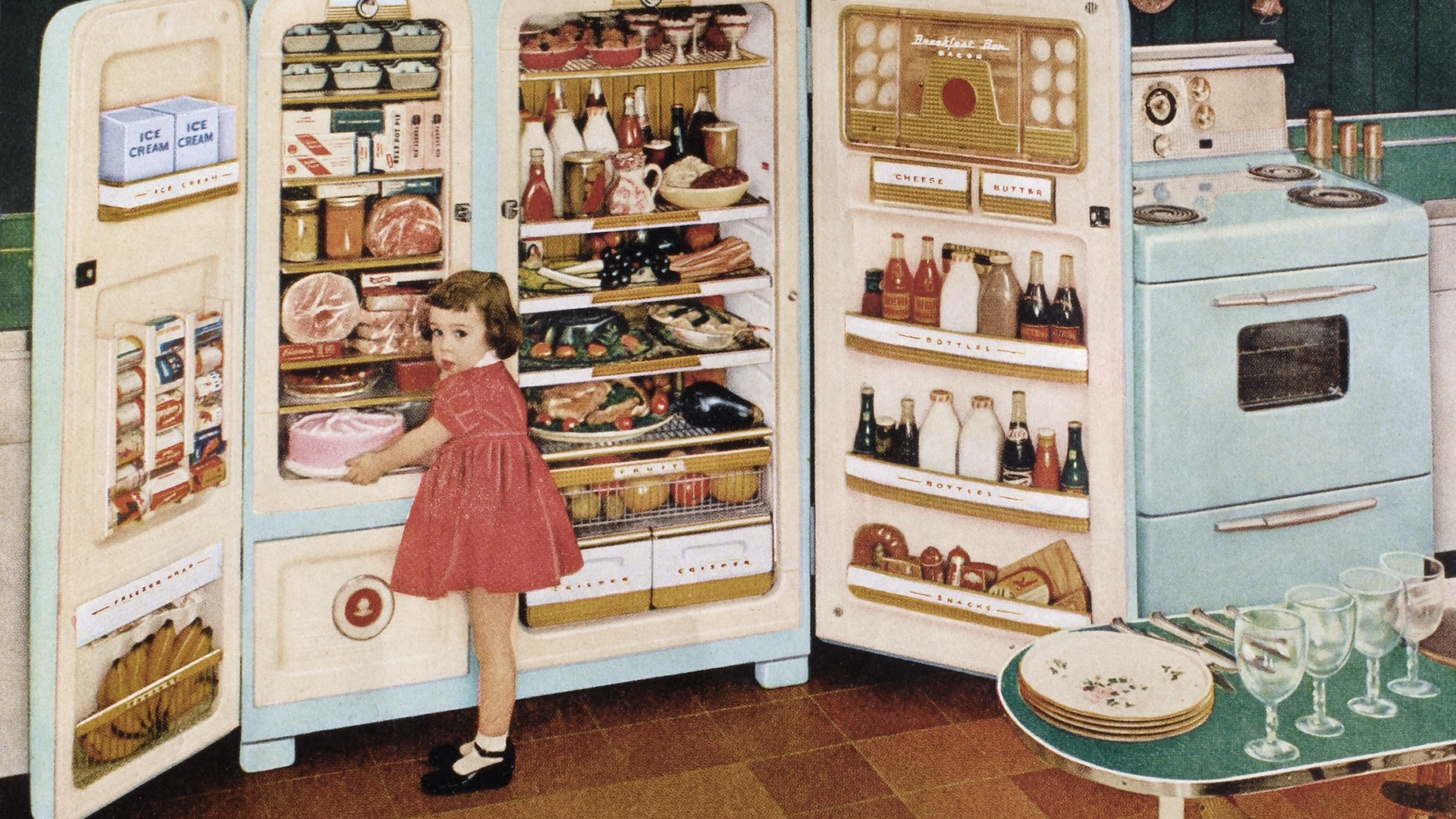
This photo is an for a fridge from 1955. Refrigerators are a relatively modern invention, but ancient people found other ways to preserve food.

Smoking cooling towers of a nuclear power plant in Rhone, France.

The earliest vaccination is thought to date back to the 10th century in China

Vintage engraving of a scene from the Boer War, wounded from the front, locating a Mauser bullet be X-Ray in a London Hospital. The Graphic, 1900