combative claims that an interstellar meteor possibly containing alien technology hit Earth a ten ago is on even shakier ground – quite literally . Last year , pieces of the meteorwere collected from the ocean off Papua New Guinea , though later analysis work into question the " exotic tech " nature of the spherule find . Now , it appears the soundwaves the team claimed were linked to the fireball were actually from the shaking of a nearby truck driving past .
What we do know is that a meteor enter the atmosphere on January 8 , 2014 – burning brightly as it did so . Using a transcription from a seismometer on Manus Island in Papua New Guinea that they linked to the meteor , controversial and prolific Harvard professorAvi Loeband his team compute that the speed of the object was consistent with an interstellar object . If confirmed , it would be only the third interstellar visitor to the Solar System make love , and the first to hit Earth . The recording also direct them to propose a localization in the sea where the debris might have landed and settle .
In 2022 , US military officialsconfirmedthe interstellar objective and the meteor ’s official nameCNEOS 2014 - 01 - 08came to be used interchangeably with Interstellar Meteor 1 . However subsequent analysis suggests that the speed of the physical object wassubstantially overestimated , and may not be of interstellar origin after all .
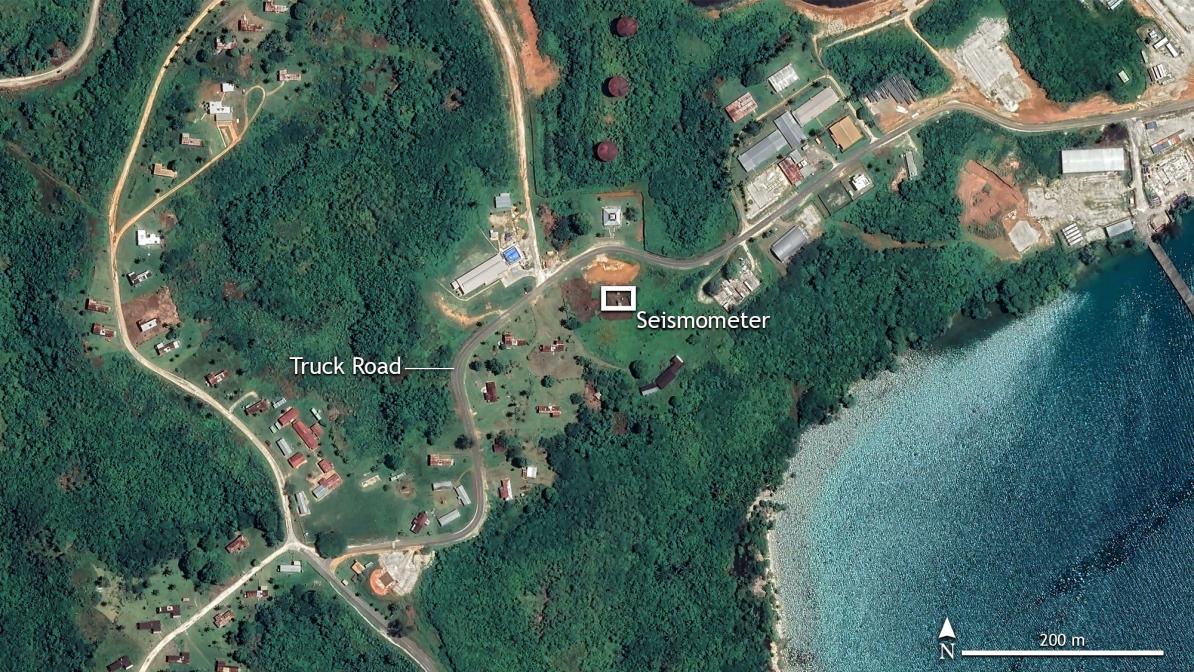
A satellite view of the seismographic station On Manus Island used by the researchers. A truck road is clearly visible.Image Credit: Roberto Molar Candanosa And Benjamin Fernando/Johns Hopkins University, With Imagery From Cnes/Airbus Via Google.
Loeb and colleagues conk out to Papua New Guinea and collected sample of these spherules , without the permissionof the commonwealth itself , which has since accused them of " theft " . The spherules hold in peculiar constituent which head the squad tosuggest , among other hypothesis , that “ this unfamiliar teemingness pattern may reflect an extraterrestrial technical origin . ”
Now , a squad from Johns Hopkins University argues that their seismal analysis is wrong too . What they linked to the meteor was " almost sure as shooting " the motion of a truck act on a nearby route . What ’s more , they put forward evidence that the meteor get into the atmospheric state elsewhere and if shard did land in the ocean they did so in a totally dissimilar place to where Loeb and squad calculated .
" The signal change directions over metre , exactly matching a road that runs past the seismometer , " Benjamin Fernando , a planetary seismologist at Johns Hopkins who led the inquiry , said in astatement . " It ’s really difficult to take a sign and support it is not from something . But what we can do is show that there are pot of signal like this , and show they have all the characteristic we ’d expect from a truck and none of the gadget characteristic we ’d expect from a meteor . "
Based on their new analysis , Fernando ’s squad judge that the more probable plaza for the meteor to have land is over 160 kilometers ( 100 miles ) from the area investigated .
" The bolide localization was really very far away from where the oceanographic expeditiousness went to remember these meteor shard , " Fernando add together . " Not only did they use the incorrect signal , they were bet in the wrong place . "
But , you might say , they find " spherules " of alien line of descent ! I read it online ! Well , analysis from another researcher has already play up how the anomalous opus was logical withhuman - made pollution , submit “ the meteoritic grounds is disfavour . ”
ⓘ IFLScience is not responsible for content shared from international sites .
As astrobiologist Caleb Scharf from NASA Ames pointed out on Twitter : “ Well , they did indeed discover evidence of a technological civilisation … right here on Earth . ”
Fernando ’s squad will present the findings on March 12 at theLunar and Planetary Science Conferencein Houston .
