When you purchase through link on our land site , we may earn an affiliate commission . Here ’s how it works .
After spending 17 year underground , trillions of cicadas will emerge this spring to squeak out their auricle - splitting mating songs and litter Sir Herbert Beerbohm Tree trunks with their eery molted skin .
It ’s weird enough thatBrood X , as this tremendous influx of cicadas is known , somehow manages to emerge all at the same time after nearly two decades beneath the grease . What ’s even weirder is that the cicadas may apply math to protect themselves from predators — well , most predators . No matter what these cicala do , they ’re still susceptible to a fungus that turns them into zombie spirit with disintegrating butts .

A Brood IX cicada (a 17-year cicada that emerges in Virginia, West Virginia and North Carolina) infected by the fungus Massospora. The bug’s back half has been replaced by fungal spores.
If this seems like a lot , well … it is . It turns out that the issue of cicadas expected this May is a story encompassing evolution , math and some seriously gross leech .
There are numerous specie of cicada , all with life cycle that occur partially underground and part aboveground . Some mintage emerge every year , others every few year . But then there are seven specie of true weirdos : periodic cicada , all of which have either 13 - year or 17 - class emergence patterns . These periodic cicala are a beloved species of entomologists and mathematician alike , because it may be no happenstance that both 13 and 17 are prime routine .
Bug math
The periodical cicadas are categorize in brood labeled by Roman numerals , based on where they come forth and how long their lifetime bicycle are . Some hap in relatively modest regions . Brood I , for deterrent example , comes out in Virginia and West Virginia every 17 years .
The brood set to emerge this year , though , is a biggie . Brood X , also known as the " Great Eastern Brood , " last come forth in 2004 . Members of this brood inhabit the District of Columbia and 15 State : Delaware , Georgia , Illinois , Indiana , Kentucky , Maryland , Michigan , New Jersey , New York , North Carolina , Ohio , Pennsylvania , Tennessee , Virginia and West Virginia .
The periodic cicada biography cycle start in the trees . Parents lay eggs in Sir Herbert Beerbohm Tree outgrowth . The unseasoned crosshatch , then " variety of commando down and tunnel down to the root , " say Joe Ballenger , an bugologist and doctoral scholar at the University of Wyoming . There , they fertilise on Sir Herbert Beerbohm Tree sap " until basically they ’re old enough to motor . "
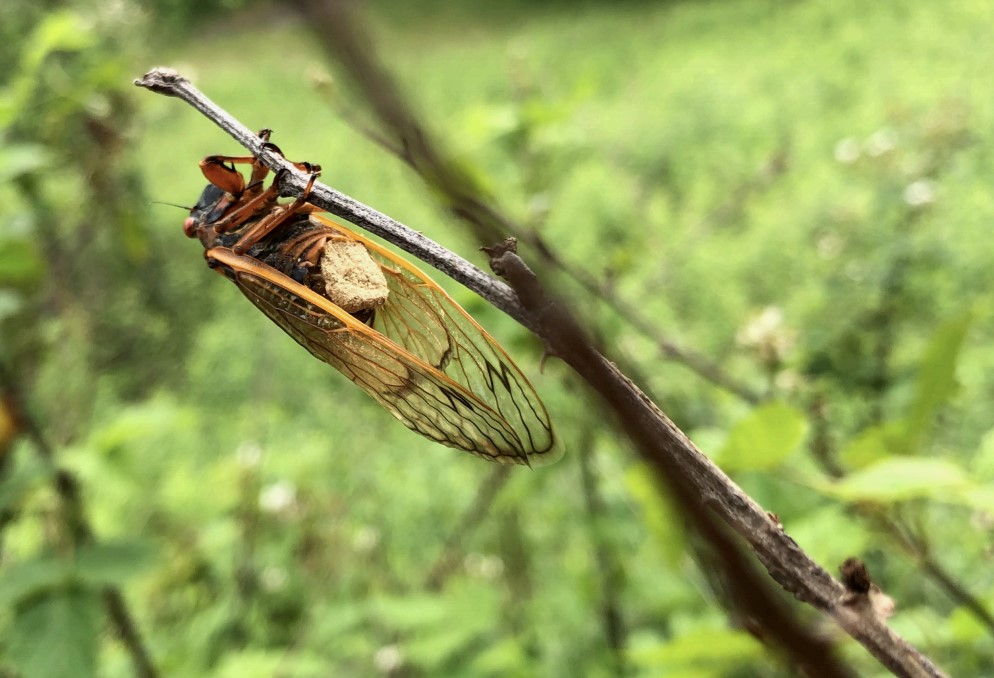
A Brood IX cicada (a 17-year cicada that emerges in Virginia, West Virginia and North Carolina) infected by the fungus Massospora. The bug’s back half has been replaced by fungal spores.
Bizarrely , the broodlings develop underground at unlike rates , Ballenger told Live Science . If a soul were to stab for cicada nymphs a decade after the brood went underground , they ’d find nymphs of various sizes and different stages of exploitation . By year 16 , though , all of the cicada nymph would be at the same stage . Somehow — and no one knows how — the debauched developers eff to wait , and the slow catch up .
At year 17 , things get exciting . When the soil warms to 64 degrees Fahrenheit ( 17.8 degrees Celsius ) , the cicala burrow out of the earth , molt and then careen around , looking for mate . The outcome is outstanding : molted carapaces deposit to everything , screeching calls occupy the air , clumsily flying bugs running directly into innocent passersby . As a child in Iowa , Ballenger once saw a cervid covered in cicadas only because the insects were everywhere and not particularly picky about where they light .
The overwhelming number of cicala emerging at once is protective . It ’s a strategy telephone piranha satiation . fundamentally , birds and other predators can scarf down as many cicala as they desire , and it really wo n’t matter ; there are so many that the insect will still be capable to reproduce in huge number .

A long recurrence interval may also blockade predators . For example , the oldest robins in the state of nature are typically around 5 or 6 years previous . That mean that a 17 - yr cicada emergence is something a robin grandmother might treat her grandchicks about , but those grandchicks may last and die without go out such a fiesta .
In other Bible , the cicala windfalls are so rare that the robins ca n’t really develop to take vantage of them . The same is true for other predators , including some vulturine wasps that capture cicadas , paralyse them and lie their eggs inside them . The wasps create only so many eggs , Ballenger assure Live Science , and the cicala issue are so unusual that the white Anglo-Saxon Protestant ca n’t plainly evolve to produce more eggs those years .
But the 13- and 17 - class recurrence of cicada emergences may be an even savvier scheme . Both 13 and 17 are prize number , mean they ’re divisible only by 1 and themselves . This means that emergences rarely overlap with predator universe cycles that occur in shorter intervals . For example , if cicadas emerge every 10 years , they ’d be susceptible to predators whose universe boomed on a bicycle of one , two , five or 10 age . If they came out every 12 years , they ’d be a tasty snack for any predator on a cps of one , two , three , four , six or 12 age . Thirteen years , though ? Only one and 13 . The same goes for a 17 - twelvemonth bike .

Glenn Webb , a biological mathematician at Vanderbilt University in Tennessee , has done mathematical molding that suggest that if periodic cicala did n’t practice prime - turn oscillation , they ’d put down dramatically in number or go extinct . In a 2001 newspaper in the journalDiscrete & Continuous Dynamical Systems , Webb compared survival in cycles ranging from 10 to 18 years . Thirteen- and 17 - year rhythm performed best , yielding a unchanging population . The other cycle options pass to fall , and 10- , 12- and 18 - year cycles led to dramatic population departure or even extinction .
Not everyone agrees that these good example are correct , Webb told Live Science , but by his math , predator cycle fall out every two to three years seem to make a big difference of opinion in cicada survival .
" It ’s a contention , " he say . " And I do n’t know when it will be settled , because it ’s not easy to conduct experiments or pull together information . "

Outwitting humans, falling to fungi
The challenge is that periodic cicadas ' farseeing living cycle per second do n’t ensnarl with human scientist ' lives very well . Most doctorial students are in their previous XX or 30s by the time they finish their computer program , and many must go on to work in someone else ’s research laboratory as postdoctoral researchers . A cicada - loving entomologist might be 40 class old by the time they get to set up their own inquiry program in periodic cicada studies . Let ’s say a 40 - year - honest-to-goodness investigator studies their first Brood X emersion this year . They ’ll be 57 the next time the bugs come around so they can gather up their 2nd round of data and then … drat , 74 and in all likelihood well into retirement . It ’s not a schedule that works well in the publish - or - perish modeling of academia .
Thus , many cicada studies are unfunded side projects , Ballenger order . " The fact that we ca n’t cognise a lot about them creates a lot of enigma , " he said .
So maybe cicadas employ select number to protect themselves , or maybe they do n’t . But there ’s one predator that they definitely do n’t outwit with math : a group of fungi called Massospora .

Massospora are truly creepy-crawly . Resting spores from the fungi infect cicadas as they burrow out of the soil in early spring . Infected cicada look normal at first , but the fungus soon colonizes their back ends , turn it into a raft of spores ( thus the name ) . The cicadas do n’t croak , though , say Brian Lovett , a postdoctoral research worker at West Virginia University who read louse - destroy kingdom Fungi . alternatively , they keep moving around , drop new spore wherever they go .
" We ’ll describe them in our lab as flying saltshaker of end , " Lovett tell Live Science .
The fungus doses the infect cicadas with an amphetamine call cathinone , which is also found in thekhatplant . This chemical compound is belike made by the fungus itself ( though the investigator are n’t sure if the fungus might induce the cicadas to make the substance ) and seems to keep the insect alert enough to keep bopping around even as their back end dissolve . The fungus also has a freaky consequence on manful cicadas it taint : Instead of flying around and call for Ilex paraguariensis , the male cicadas start act like females , flicking their wings in a way that suggest they ’re receptive to an romantic male person .

" Since the back half of the body has been infect with spores , rather of mating with the cicadas [ the approaching males ] get infected with the fungus , " Lovett said .
It ’s possible the fungus bring out a compound that switches on this distaff behavior , Lovett said . It ’s also potential that it ’s just a side force of the male ’s reproductive organs disintegrate that also benefits the fungus .
— psyche control : A verandah of snake god ant

— 20 startling fact about insects
— No creepy - crawlies here : Gallery of the cutest bugs
Massospora do n’t only infect periodical cicadas ; they also like annual cicada . That means they ’re not dissuaded by 13- or 17 - year cycles . These massive cicala universe swelling are a blessing to the kingdom Fungi , Lovett say , and a important proportion of the cicada population is credibly infect by the end of the season . However , predator satiety still holds . There are so many more cicadas than the spores could possibly taint before couple season is over that the overall cicada numbers stay strong .

Lovett and his colleagues are working on genetically sequencing Massospora specie to understand how they ’re related and how they ’ve co - evolved with their cicala host . They ’re also render to figure out if and how the fungus produces the amphetamine and the behavioural change in male cicada . Because the fungi conveniently infect cicada that emerge each class , it ’s easier to investigate these dubiousness . Brood X , on the other paw , might hold on to its mystery well into the future .
" I think the question will be of interest 100 years from now , " Webb said .
Originally publish on Live Science .